

Dependent Spaces
Dependent spaces let you link courts or spaces that share a physical footprint — like a full tennis court that can also be split into two pickleball courts. When one space is booked, OpenCourt automatically blocks off the others in the same time window, across reservations, events, and programs. No more double-bookings or manual coordination. Just set up the rules once and OpenCourt handles the rest.
Who Can Configure This
Dependent Spaces rules can be created and managed by both club admins and Super Admins.
How to Add a Rule
-
Go to Settings → Spaces and Categories.
-
Scroll down to the Dependent Spaces section.
-
Click + Add rule.
-
In the Primary space dropdown, select the space that, when booked, should block the others.
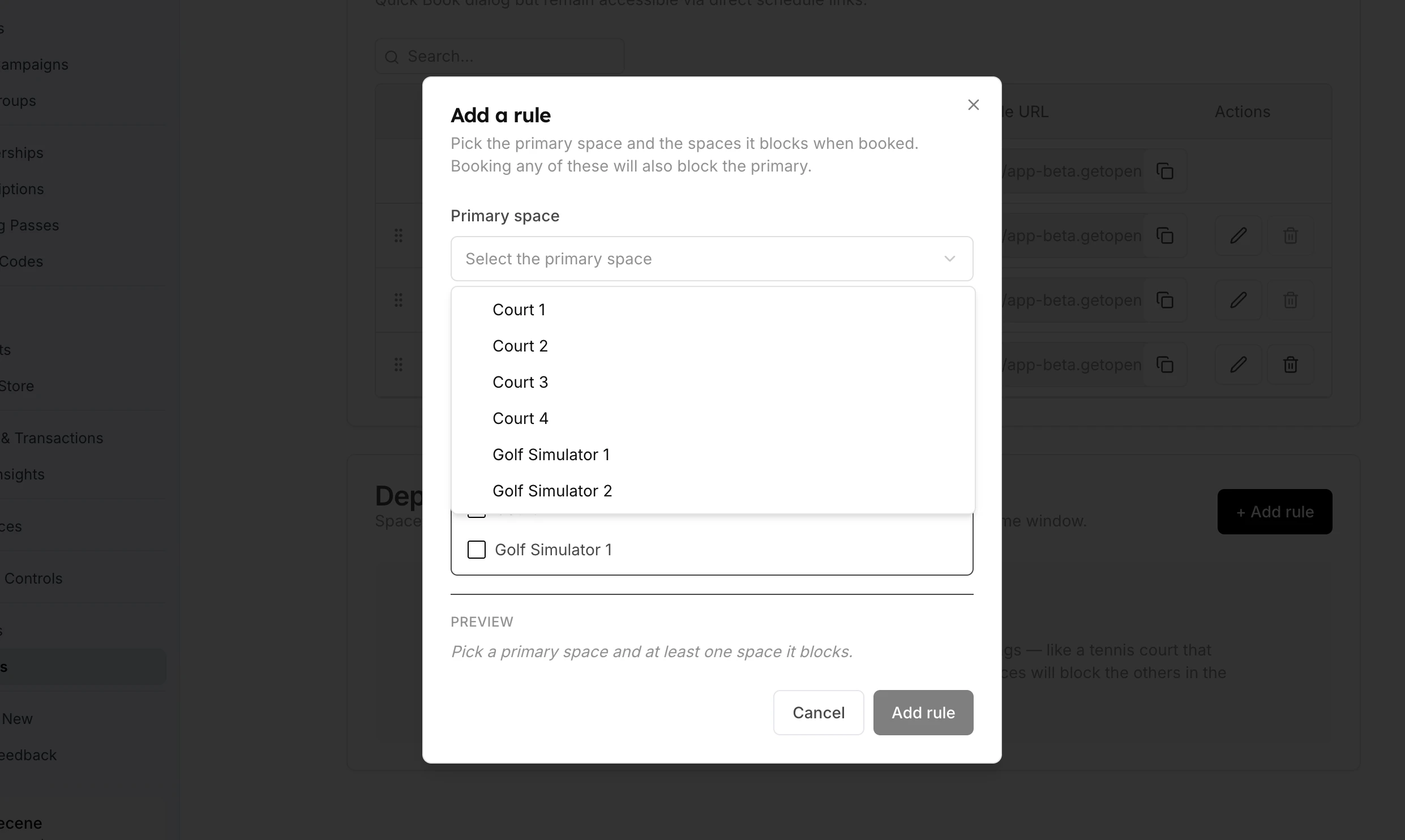
-
Under Blocks these spaces, check every space that should be blocked when the primary is booked.
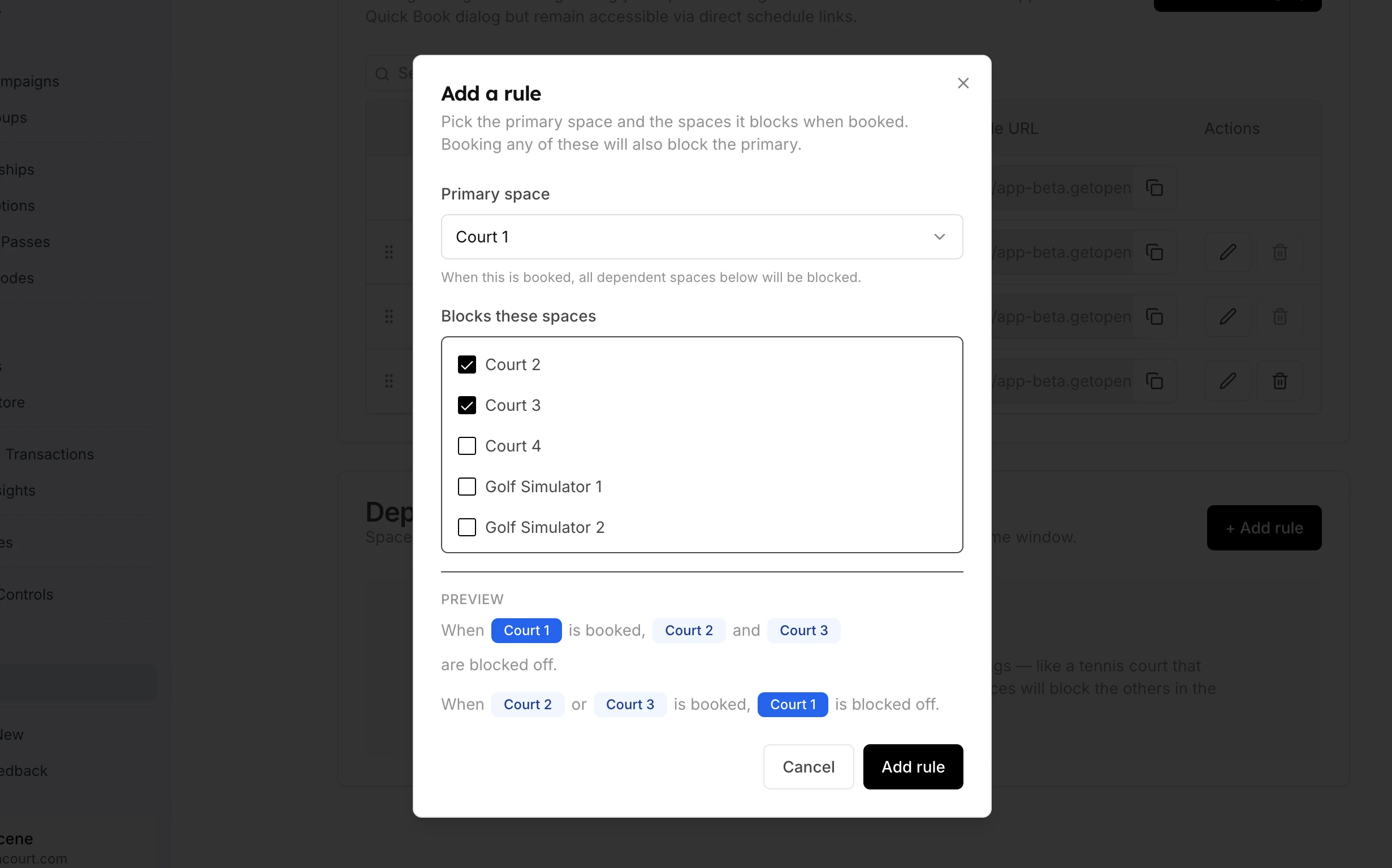
-
Review the Preview at the bottom of the modal to confirm the logic looks correct.
-
Click Add rule to save.
How the Rule Works
Dependent Spaces rules are bidirectional. You don't need to create a second rule in reverse — OpenCourt applies blocking both ways automatically.
Example: Primary space = Court 1 (Tennis). Blocks = Court 2 (Pickleball) and Court 3 (Pickleball). → When Court 1 (Tennis) is booked, Court 2 and Court 3 are both blocked off. → When Court 2 or Court 3 is booked, Court 1 is blocked off. → If an event or program is created on Court 1, Court 2 and Court 3 are blocked for that time window too.
What the User Sees
When a dependent space is blocked, it appears greyed out with a striped pattern on the schedule — users won’t see a booking option for that time slot. No error message is shown; the space simply looks unavailable, the same way an already-booked court appears.
In the example below, Court 1 is reserved and Courts 2 and 3 are automatically blocked off for the same time window.
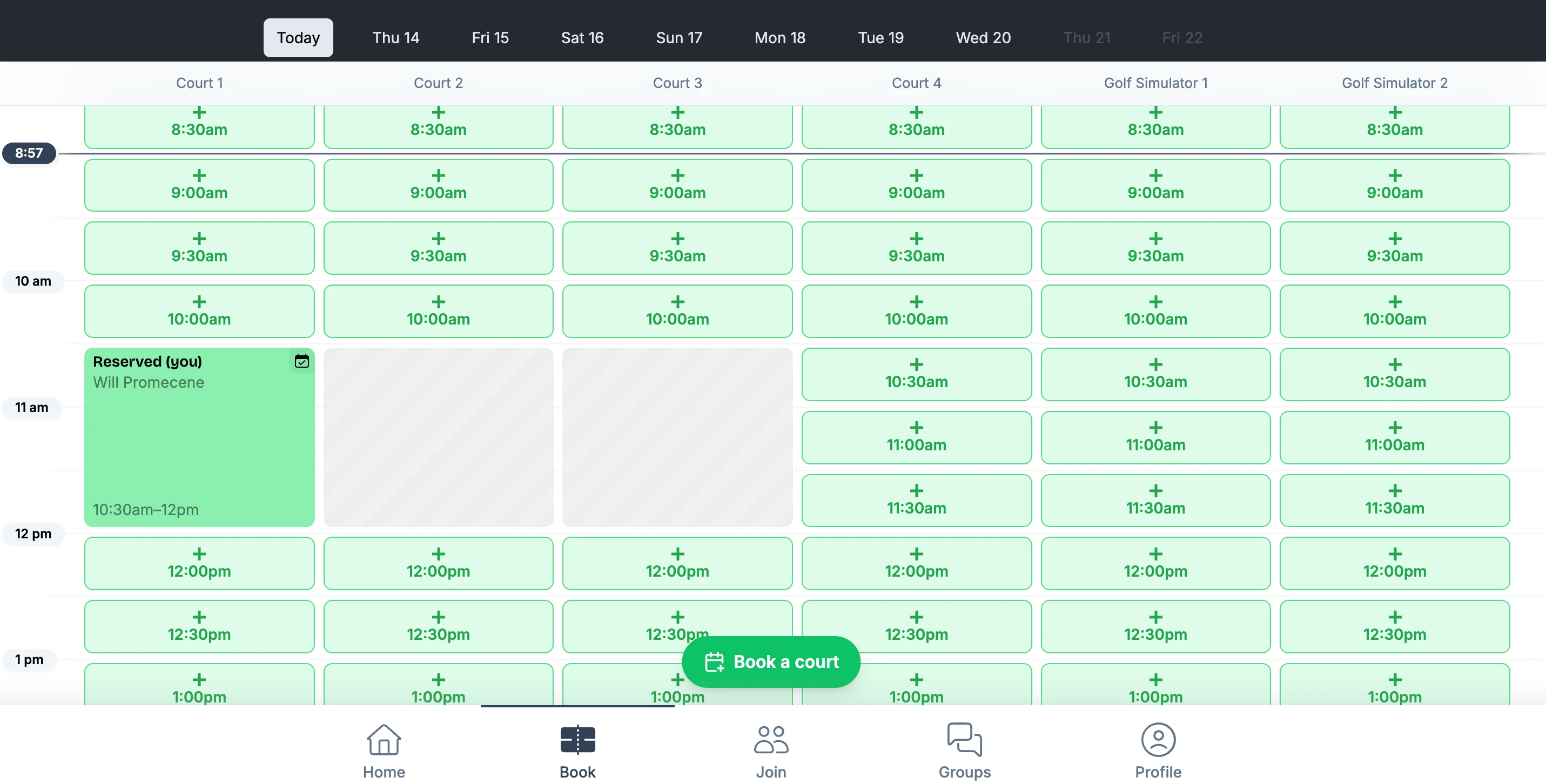
Editing or Deleting a Rule
Each rule in the Dependent Spaces list has an edit (pencil) and delete (trash) icon. Click the pencil to update which spaces are linked, or the trash icon to remove the rule entirely.
💡 Tip: The primary space won't appear in the "Blocks these spaces" checkbox list — only the other spaces are shown. This prevents you from accidentally creating a self-referencing rule.
Event Tags
Event tags let you organize and categorize your events with custom labels like "Beginner", "Advanced", "Ladies Night", "Youth", or anything that fits your club. Tags show up as colored badges on events in the admin panel, and — more importantly — they can replace the default event type tabs on the user-facing Join page with your own custom filters. Tags also integrate with booking passes, so you can create passes that only work for events with certain tags (e.g., a "Beginner Clinic Pass" that only applies to events tagged "Beginner").
Skill Rating: Create Balanced and Competitive Games
The Skill Rating feature helps clubs organize events where players are evenly matched — ensuring every game feels competitive, fair, and fun. Nothing frustrates players faster than joining a group that’s too advanced or not challenging enough. By setting skill levels, you create consistent, enjoyable experiences that keep players coming back.